There’s a moment — standing beneath the soaring arches of a centuries-old haveli, or tracing your fingers across stone carved with impossible patience — when you understand something no design textbook can teach. Great architecture doesn’t age. It evolves.
Across India and around the world, a quiet but powerful shift is happening in how we think about premium homes. The most compelling luxury residences being built today are not racing toward the future. They’re reaching back — to Mughal courtyards, to Roman symmetry, to the temple geometry of Dravidian craftsmen — and finding there a vocabulary of space, material, and meaning that no contemporary trend can replicate.
This is the return of timeless architecture. And it’s reshaping what a truly extraordinary home looks like.
Why Ancient Architecture Still Feels Luxurious
Walk through any showroom of modern interiors and you’ll find a sameness — glass, steel, neutral palettes, clean lines. These aren’t bad choices, but they share a problem: they lack memory. They feel like they belong to no place and no time.
Ancient architecture carries the opposite quality. Whether it’s the proportion of a Greek colonnade, the rhythmic repetition of a Mughal arch, or the deeply inset windows of a Rajasthani fortress, these forms resonate because they were shaped by centuries of refinement. Not by trend cycles, but by generations of builders who understood scale, light, shadow, and human experience.
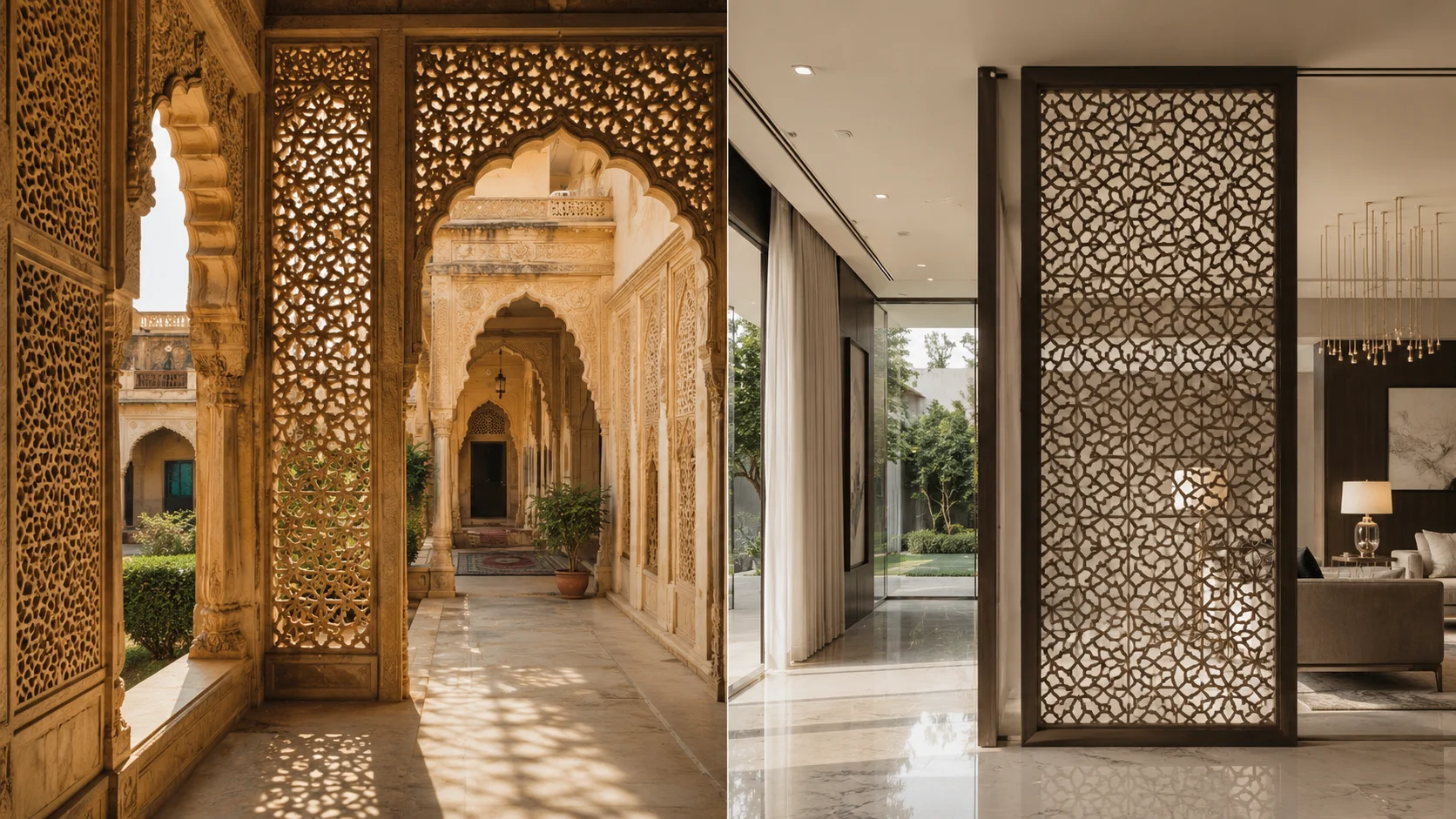
There’s also a sensory depth to heritage design that modern construction rarely achieves. The thickness of a stone wall that keeps interiors cool in summer. The way a jaali screen fractures afternoon light into something almost sacred. The warmth of hand-carved teak against smooth limestone. These aren’t decorative choices — they’re architectural decisions that affect how a space feels to live in.
That’s the real definition of luxury: not price per square foot, but the quality of daily experience.
Ancient Architectural Elements Returning in Modern Homes
The revival isn’t nostalgic. It’s selective, intelligent, and deeply considered. Here are the elements appearing with increasing frequency in premium residential design today:
Arched doorways and vaulted ceilings — Borrowed from Roman basilicas and Mughal palaces alike, arches are replacing flat lintels in entrance halls, courtyards, and living rooms. They create a sense of arrival, a psychological shift from outside to inside, that a standard door frame simply cannot.
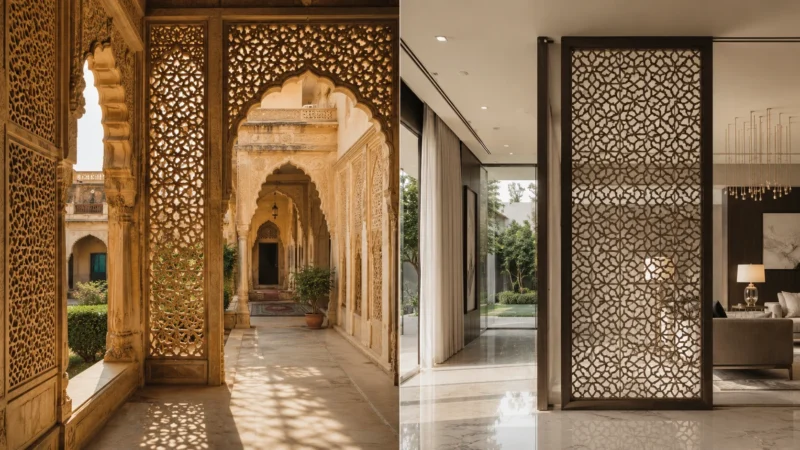
Jaali and lattice screens — The perforated stone screens of Rajput architecture are being reinterpreted in wood, metal, and even concrete. They divide spaces without closing them, filter natural light with extraordinary beauty, and provide privacy without walls.
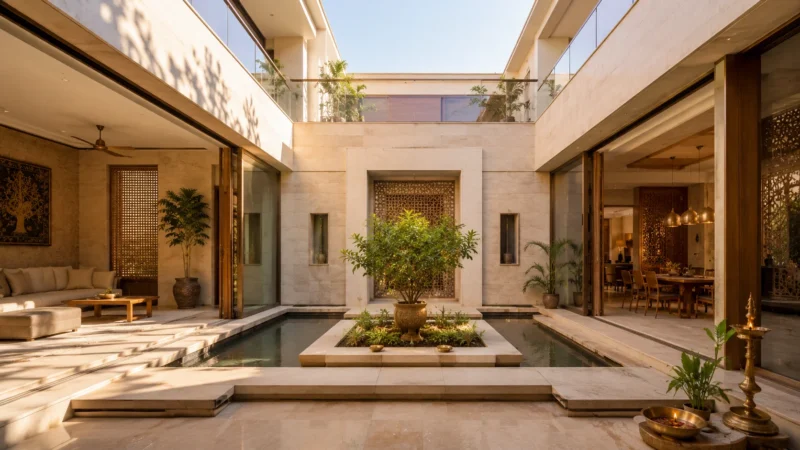
Courtyards and water features — The ancient Indian concept of the chowk — an open inner courtyard — is returning as a central organizing principle in luxury villas. Combined with reflective pools or fountains, these spaces bring sky, breeze, and birdsong into the heart of a home.
Column-lined verandahs — Greek and Roman colonnades evolved independently in Indian temple architecture as the mandapa. Today, shaded colonnaded galleries along a home’s perimeter are among the most requested features in premium residential design.
Natural stone and lime plaster — After decades of synthetic finishes, the materials of the ancients — sandstone, kota stone, lime plaster with its subtle organic variation — are back on architects’ specification sheets.
Indian Heritage Influence in Contemporary Luxury Design
India’s architectural legacy is staggeringly diverse, and each regional tradition offers its own vocabulary of form.
Mughal architecture — with its calibrated geometry, inlaid marble work, and the breathtaking refinement of pietra dura — translates beautifully into contemporary interiors. A foyer with arched niches and pale marble flooring doesn’t need to announce its inspiration. It simply radiates a particular stillness and grandeur.
Rajasthani haveli architecture brings something different: a layered richness, where carved sandstone façades, ornate brackets, and deep-set balconies create buildings that seem to have accumulated beauty over generations. Modern interpretations distill this to its essence — a carved stone panel here, a painted archway there — without becoming costumed.
South Indian temple architecture, with its mathematical precision and sculptural density, influences spatial planning more than surface decoration. The concept of graduated approach — moving through spaces of increasing sanctity and calm — is directly applicable to how we sequence rooms in a well-designed home.
Vastu Shastra, India’s ancient science of spatial harmony, underpins much of this design thinking. Its principles of orientation, proportion, and elemental balance align remarkably well with contemporary ideas about biophilic design and psychological wellbeing. The most thoughtful luxury residences today integrate vastu not as ritual compliance, but as a genuine design philosophy.
Materials, Symmetry, and Craftsmanship
What separates heritage-inspired design from mere pastiche is the commitment to material truth and craft.
Ancient builders used stone because it was structural. They carved it because skilled hands were available and beauty was considered inseparable from function. When we bring these materials back today, the same logic applies — the weight, warmth, and texture of natural stone cannot be mimicked by tiles printed to look like it.
Symmetry is another defining quality. Classical architecture — whether Greco-Roman or Mughal — is deeply symmetrical, and this isn’t coincidental. Bilateral symmetry is processed by the human brain as order, stability, and calm. A symmetric façade or a balanced room plan produces a measurable sense of ease that asymmetric modernism, however dynamic, rarely achieves.
Handcrafted detail matters at a different scale. A hand-turned wooden baluster, a mosaic threshold, a plastered ceiling with shallow relief — these are things you notice without consciously registering them. They accumulate over years into the sense that a house has been cared for, attended to, loved.
Modern Luxury Homes Inspired by History
The most compelling contemporary villas blending historical and modern design aren’t museums. They breathe. They live.
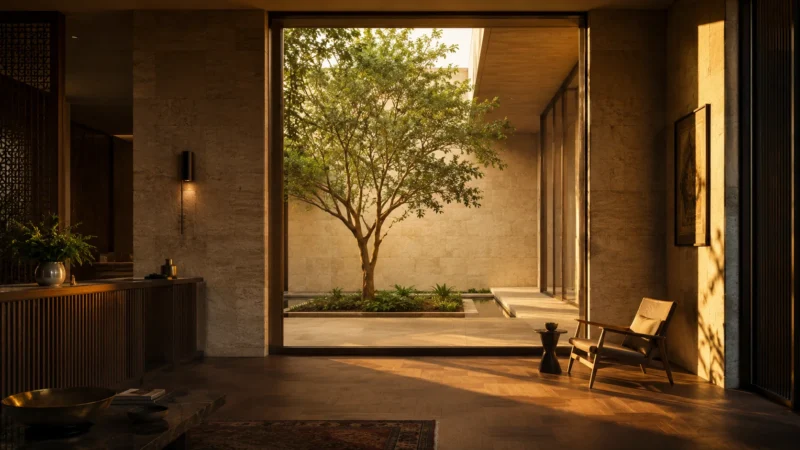
Double-height living rooms with exposed stone walls and wide glass openings toward private gardens. Bedrooms with domed plastered ceilings and low wooden platforms inspired by Mughal diwan-e-khas. Bathrooms with hand-cut stone basins, arched niches for candles, and underfloor heating beneath centuries-old surface materials.
The dialogue between old and new is where the real artistry lies. A raw concrete column beside a sandstone arch. A minimalist kitchen — handleless, stainless, efficient — opening through an ornate teak doorway into a traditional dining space. These contrasts aren’t contradictions. They’re conversations.
How Naksha Planet Blends Timeless Design with Modern Living
At Naksha Planet, this design philosophy isn’t an aesthetic trend to follow — it’s a deeply held conviction about what makes a home truly extraordinary.
Every project begins with questions about context: the climate, the site, the family’s relationship with their own cultural inheritance. A home in Rajasthan responds differently to heritage than one in Kerala or Maharashtra. What carries across all of them is the belief that great architecture must be rooted — in place, in material, in memory — to achieve the kind of presence that makes a house feel genuinely irreplaceable.
The team at Naksha Planet brings together expertise in contemporary structural design with a serious engagement with India’s architectural traditions. The result is homes that feel modern without being sterile, and traditional without being imitative.
If you’re planning a premium home and want it to carry the weight of real design intelligence — the kind that takes centuries of human wisdom as its foundation — explore what Naksha Planet can create for you.
The Architecture That Outlasts Trends
History keeps proving a simple truth: the buildings that endure are those that were built with intention, material honesty, and a respect for human experience at their core. The Parthenon still draws the eye. The Taj Mahal still silences conversation. A beautifully proportioned haveli still feels more alive than most things built last year.
The return of ancient architectural principles in modern design isn’t a retreat from progress. It’s the recognition that some forms of knowledge are genuinely timeless — and that the most forward-thinking thing an architect can do is know which ones to carry forward.
Your home deserves that depth.