There Is a Moment Before You Settle In
You have felt it before — though perhaps you never found the words for it.
You step through a doorway and something shifts. The air carries a particular quality. Light falls at an angle that feels almost deliberate. The proportions of the room seem to hold you rather than contain you. Without knowing why, your shoulders release. Your breath slows. You feel, immediately and wordlessly, that you belong here.
This is not coincidence. It is not decoration. It is architecture speaking its oldest, truest language — one that bypasses the intellect entirely and reaches something far more primal: the emotional body.
The finest spaces in the world are not defined by their materials or their square footage. They are defined by how they make you feel the moment you enter them. This is the geography of belonging — and it is the invisible dimension of every home worth living in.
Why Humans Attach Emotionally to Spaces
Architecture and neuroscience are slowly arriving at the same conclusion: our relationship with space is deeply psychological. The brain does not process a room the way a camera does — cataloguing edges, colours, and dimensions. It reads atmosphere. It registers safety, warmth, memory, and meaning in the same breath it takes to cross a threshold.
Human beings are territorial not out of aggression, but out of need. We require spaces that reflect who we are, that absorb our routines, that hold the evidence of our lives. A home is, in the most literal neurological sense, an extension of the self.
When a space aligns with our inner world — when its scale, its light, its textures speak to some deep expectation we did not know we carried — we experience what psychologists call place attachment. A felt sense of continuity between who we are and where we are. The space becomes part of our identity, the backdrop against which memory is made.
This is why we grieve demolished buildings. Why childhood homes hold a gravity no other place can replicate. Why some hotel rooms feel like exile and others feel like grace.
Architecture Beyond Walls and Materials
There is a persistent misunderstanding about what architecture actually is.
It is not the walls. It is what happens between them. It is the relationship between ceiling height and human scale. The quality of morning light on a particular wall. The way a corridor narrows slightly before opening into a room, creating unconscious anticipation. The decision to place a window not for a view, but for the precise angle of late afternoon sun in December.
These are not details. They are the architecture.
Materials matter — the warmth of teak, the cool solidity of stone, the soft weight of plaster walls — but they are vocabulary, not meaning. Meaning arises from how they are arranged, how they respond to light, how they age with you. A home built only for the photograph is a beautiful shell. A home built for lived experience becomes something far more rare: a sanctuary.
The Psychology of Belonging in Home Design
Belonging, as a psychological need, sits at the centre of the human condition. We need to feel claimed by a place — and in return, to claim it. A home that achieves this becomes a partner in our inner life.
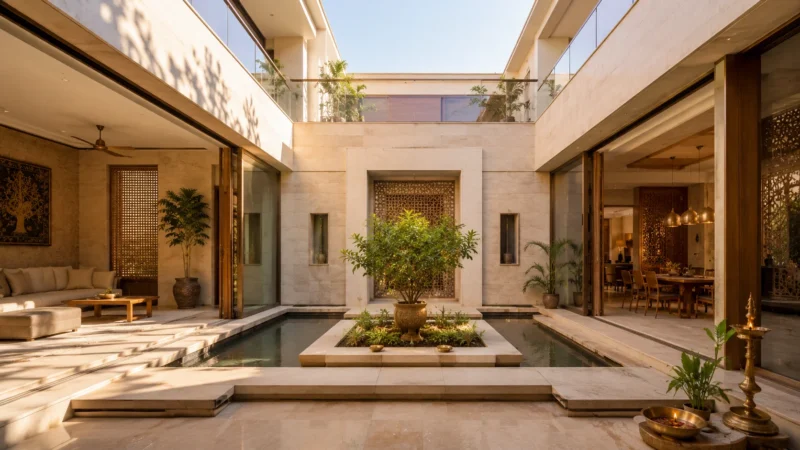
This happens through several quiet architectural acts. Threshold design — the transition from outside world to private one — signals to the nervous system that it is safe to arrive. Proportions that honour the human body rather than impress it create ease rather than awe. The strategic placement of silence — a courtyard, an alcove, a window seat — gives the mind somewhere to exhale.
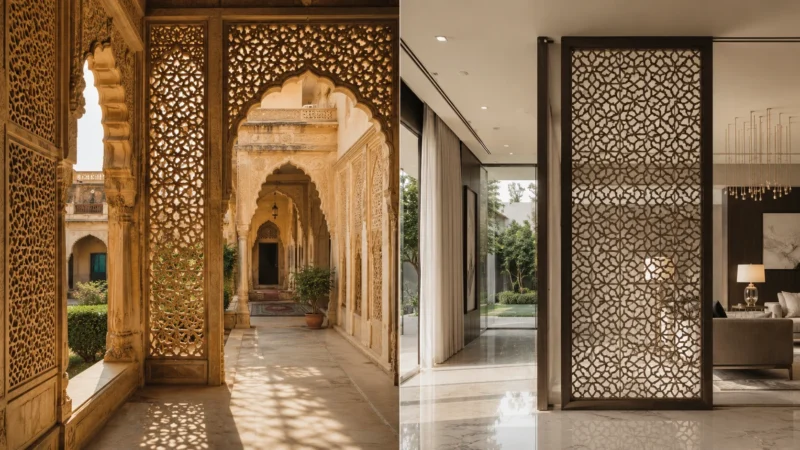
In the Indian context, this understanding runs ancient and deep. The concept of vastu at its philosophical core is precisely this: the alignment of built form with human wellbeing. The desire for a home that does not merely house the body but nourishes it. The instinct that orientation, flow, and natural light are not aesthetic preferences but requirements.
Modern luxury architecture is rediscovering what traditional wisdom always knew: the most important room in a house is the feeling inside it.
Light, Silence, Texture, and Memory
Four elements shape spatial experience more than any other: light, silence, texture, and memory.
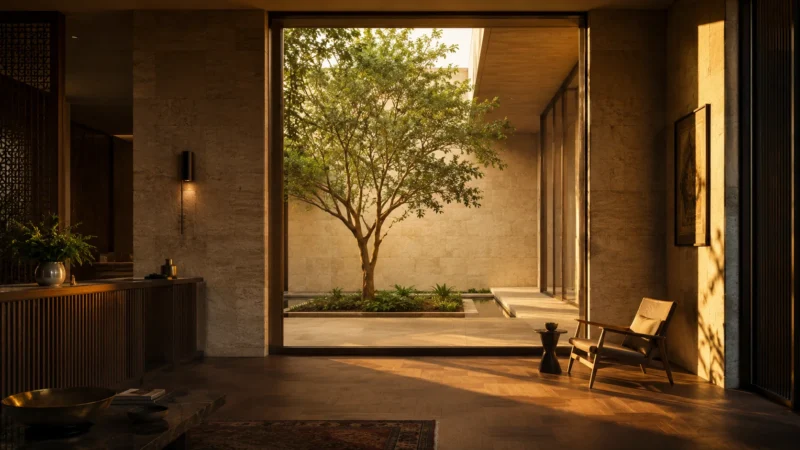
Light is the most powerful tool an architect possesses. It does not merely illuminate — it narrates. Morning light in a bedroom, arriving at a gentle angle, creates a quality of beginning. Filtered afternoon light through a screen of leaves produces calm. A single shaft of sunlight crossing a stone floor at dusk is more emotionally complex than any artwork you could hang on a wall.
Silence — architectural silence — is not the absence of sound. It is the presence of stillness. A home with considered acoustics, with rooms that absorb rather than amplify, becomes a refuge from the relentless density of modern life.
Texture is the sense memory of a home. The slight roughness of a lime-plastered wall beneath your fingertips. The give of a heavy wooden door. The particular coolness of a tiled floor on a summer afternoon. We remember spaces the way we remember people — through sensory impression, not specification.
And memory itself is architectural. A home that allows memory to accumulate — through its proportions, its materials, its quality of permanence — becomes a living archive of your life. The kind of space you carry with you long after you have left it.
Why Modern Luxury Is Becoming More Emotional
The most significant shift in luxury architecture over the last decade is not aesthetic. It is philosophical.
Affluent, design-conscious clients no longer want homes that signal wealth. They want homes that cultivate peace. They want materiality that ages gracefully. Light that changes through the day. Spaces that feel equally beautiful empty as they do filled with life.
Biophilic design — the deliberate integration of natural elements, views, ventilation, and living materials — has moved from niche philosophy to dominant practice precisely because it addresses what purely visual architecture cannot: the nervous system’s ancient need to feel connected to the natural world.
The new luxury is not more. It is deeper.
How Naksha Planet Designs Spaces That Feel Alive
At Naksha Planet, architecture begins with a question that most design processes never ask: How do you want to feel here?
Not what style you prefer. Not which finishes you admire. But what emotional life you want your home to support. What quality of morning you want to wake into. What kind of evening you want the house to hold.
From that starting point — emotional intent — every spatial decision follows. The orientation of the primary living space in relation to prevailing light. The sequence of arrival, the compression and release of scale. The choice of materials for their sensory quality, not merely their visual appeal. The creation of spaces within spaces — corners of quietude, thresholds of transition, rooms that breathe.
The result is not a house that photographs beautifully, though it will. It is a home that, five years from now, still feels like the best decision you ever made.
A Home Is Not Measured in Square Feet
A home is measured in the quality of evenings spent within it. In the particular light of a Sunday morning. In the feeling of returning after a long journey and exhaling the moment you cross the threshold.
It is measured in the memories it holds and the ones it is still waiting to accumulate. In the way it grows with you — accommodating not just your life as it is, but the life you have not yet imagined.
The finest architecture does not announce itself. It simply makes everything else feel more possible.
If you are building a home — not a house, but a true home — the conversation worth having is not about square footage or surface finishes. It is about belonging. About the invisible relationship between the people you are and the place that will hold you.
That conversation is one Naksha Planet is always ready to begin.
Naksha Planet designs emotionally intelligent, spatially considered luxury homes across India. If you believe your home should feel as meaningful as it looks, we would be honoured to design it with you.